EN
 AR
 BG
 CS
 DA
 NL
 FI
 FR
 DE
 EL
 HI
 IT
 JA
 KO
 NO
 PT
 RU
 ES
 SV
 TL
 ID
 LV
 UK
 VI
 GL
 HU
 TH
 TR
 AF
 MS
 GA
 BE
 BN
 EO
 JW
 LA
 MN
 MY
 UZ
 GD
ICEMA BMF100 10-Tonne-Class Flake Ice Machine
Connecting Blade Design with Refrigeration and Manufacturing
ICEMA’s BMF100 10-tonne-class flake ice machine brings blade geometry, evaporator construction, refrigeration and electrical control together around a defined product requirement: small ice flakes. The machine combines a chrome-plated carbon steel evaporator with a Bitzer screw compressor, an air-cooled condenser and R404A refrigerant. A Siemens PLC and an MCGS operator screen provide the control platform, linking the physical ice-making process with equipment operation.
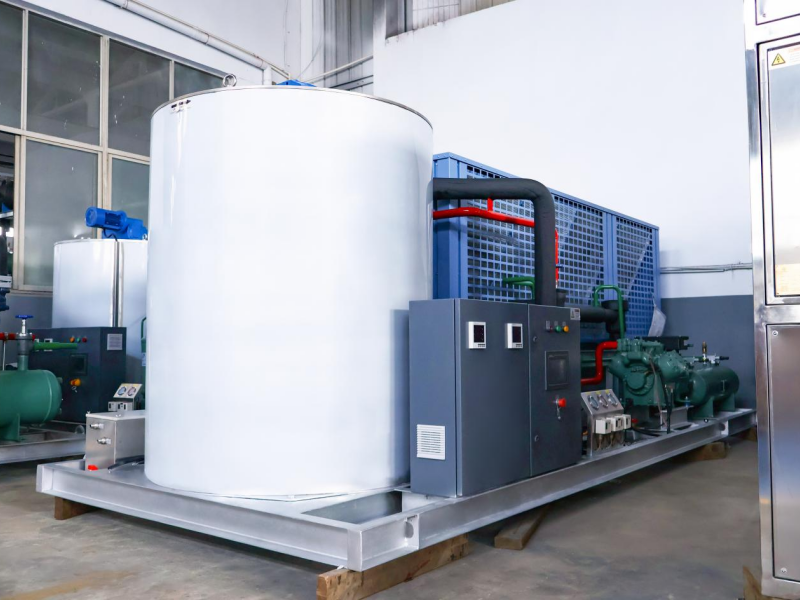
The production process begins with water freezing into a thin layer on the evaporator’s ice-forming surface. An ice blade then removes and breaks that layer into flakes. The evaporator establishes the freezing conditions, while the blade directly influences how the ice is divided during harvesting. Producing the required flake size therefore depends on coordinating thermal conditions with the geometry and movement of the harvesting mechanism.
For small-flake production, the spacing between blade teeth is a significant design variable. Reducing that spacing allows the teeth to divide the ice layer at closer intervals during scraping, helping produce smaller flakes. This translates the desired ice form into a specific mechanical design choice. Final flake characteristics also depend on ice thickness, blade clearance and the operating condition of the drive assembly, which must work together with the selected tooth

The evaporator provides the working surface for this interaction. Its chrome-plated carbon steel construction combines a metal substrate with a treated surface, making machining precision, coating consistency and dimensional control relevant manufacturing priorities. Blade positioning and travel must match the evaporator geometry. The reduction drive also needs accurate installation so that ice formation and mechanical removal remain coordinated throughout the harvesting process.
While blade design determines how the ice layer is divided, the refrigeration circuit supplies the cooling needed to form that layer. The BMF100 uses a Bitzer screw compressor and R404A refrigerant, with a three-phase, 380 V, 50 Hz electrical supply. The compressor operates as part of a circuit that includes the evaporator, condenser and refrigerant feed components. Matching these elements supports the freezing conditions required by the mechanical harvesting process.
Refrigerant delivery is managed through four Danfoss expansion valves and a Danfoss liquid supply solenoid valve. The expansion valves provide throttling and regulate refrigerant feed, while the solenoid valve controls the opening and closing of the liquid supply path. These functions connect refrigerant flow with the equipment’s operating sequence. Correct valve orientation, piping connections and assembly quality are important to implementing the intended circuit arrangement.
Supporting components extend the circuit’s functions beyond compression and refrigerant delivery. An oil separator, a gas-liquid separator, a filter drier and a return gas filter address oil management, phase separation and filtration. Together, they support the operating requirements of the main refrigeration components. Clean piping, sound joints and correct component installation remain important throughout assembly, because the completed circuit depends on the quality of its connections as well as its component selection.
At the heat rejection stage, the air-cooled condenser transfers heat from the refrigerant to the surrounding air. The evaporator, compressor, condenser and auxiliary components are arranged on a common base, providing a shared structural foundation for mechanical installation, piping and electrical connections. This layout brings component support, pipe routing and service access into the assembly process. At the installation site, suitable ventilation and maintenance clearances are necessary considerations around the condenser.
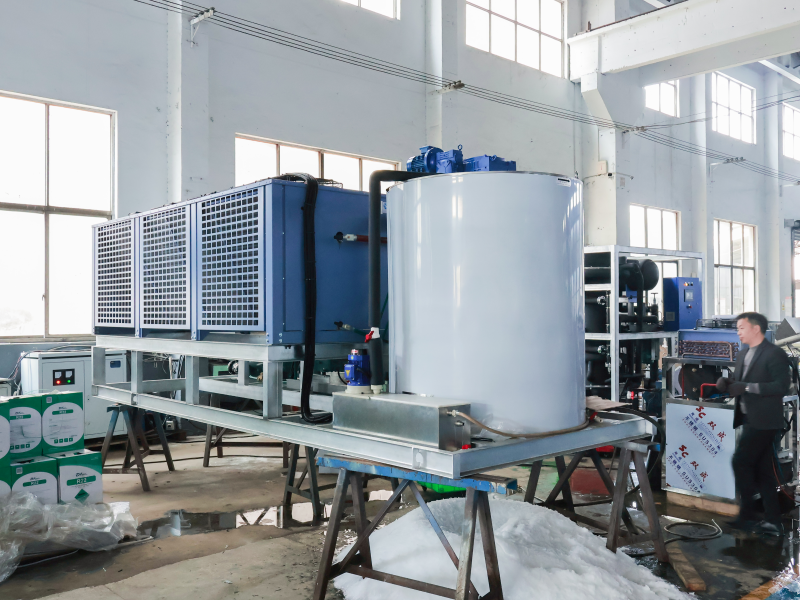
Electrical control builds on this mechanical and refrigeration arrangement. The Siemens PLC and MCGS screen provide the platform for control logic and operator interaction. Pressure gauges and Danfoss pressure controllers support pressure monitoring and related control functions. Schneider circuit protection devices, AC contactors, thermal relays and a phase sequence protection relay provide the corresponding switching and protection functions. The final operating sequence is established through the electrical design and programmed logic.
Manufacturing quality control follows the same chain as the production process. Evaporator finishing and blade alignment influence freezing and harvesting; valve and piping assembly affect refrigerant circulation; electrical connections and protection settings support control execution. Equipment positioning, secure mounting, orderly pipework and exterior workmanship are checked against the design requirements. Product quality and appearance also form part of the third-party inspection scope, connecting assembly discipline with the finished machine’s physical condition.
After production, a separate cold room provides the project’s low-temperature storage stage. Measuring 3 m by 4 m by 2.5 m, it has a specified temperature requirement of −5°C and uses an independent Copeland refrigeration system. Its construction includes 100 mm polyurethane insulation panels and a cold air blower. The ice machine and cold room serve successive production and storage functions, with their placement coordinated around ice transfer and retrieval.
The BMF100’s engineering approach follows a clear progression: define the desired flake form, establish blade geometry, coordinate the evaporator and drive, and support that process with refrigeration and controls. Closer blade tooth spacing provides a mechanical route towards smaller flakes, while manufacturing accuracy connects the individual systems into a complete machine. The resulting configuration places product development emphasis on the relationship between ice formation, controlled harvesting and the practical requirements of assembly and storage.
Hot News
-
ICEMA BMF100 10-Tonne-Class Flake Ice Machine
2026-10-15
-
ICEMA 10-Ton Direct-Cooling Block Ice Machine Combines Refrigeration and Ice Handling Technology
2026-10-10
-
Chile New Ice Plant Equipped with a 5T/24h Tube Ice Production and 5 kg Automatic Packing System
2026-09-14
-
25-Ton Tube Ice Machine Project in Changzhou Enters Assembly Stage for Reactor Cooling
2026-09-10
-
15T Brine Block Ice Machine for a Dominican Republic Ice Plant: Flexible Supply for Large-Scale Ice Production
2026-08-26
-
Order Delivery of Six 30-Ton Seawater Flake Ice Machines for Catch Preservation on Ocean-Going Fishing Vessels
2026-07-28
-
ICEMA Ships 40T Direct Cooling Block Ice and Cold Room Project to Mexico for Broccoli Preservation
2026-06-18
-
Addressing Power Grid Fluctuations: Parallel Piston Compressor Solutions for Industrial Tube Ice Machines
2026-05-06
-
Empowering Cold Chain Upgrades in SE Asia: Shanghai Icema to Exhibit at Indonesia Cold Chain Expo 2026
2026-05-05
-
Côte d'Ivoire Client Revisits ICEMA, Deepening Cooperation to Write a New Chapter in Ice Making
2025-07-16